
Boardroom Tool
The Board’s Role in Ransomware Preparedness and Response
Structure oversight of ransomware preparedness and response, by focusing on risk governance, scenario planning, and decision-making under pressure.


Chapters Near You
The Chapter Network is one of the most valuable benefits of NACD membership. It’s a coast-to-coast governance community for actively engaged directors looking to cultivate meaningful peer relationships.
Chapters Near You
The Chapter Network is one of the most valuable benefits of NACD membership. It’s a coast-to-coast governance community for actively engaged directors looking to cultivate meaningful peer relationships.

Boardroom Tool
Building a Relationship Between the Board and CISO
This tool, featured in the fifth edition of the NACD-ISA Director's Handbook on Cyber-Risk Oversight, outlines how boards can strengthen relationships with cyber-risk leaders to promote strategic integration, resiliency, transparency, accountability, and trust.
Boards cannot oversee cyber risk effectively if they only interact with the CISO during annual presentations or after a crisis has occurred. Sustained, structured engagement with the CISO (or the equivalent person who is accountable for cybersecurity for the corporation) helps directors view cybersecurity as an enterprise-wide strategic concern rather than a technical sidebar.
The CISO’s rise to the C-suite comes with more engagement with the boardroom, an audience with the CEO, and the power to make strategic decisions for the business. The CISO is a critical executive role that should receive board-level coaching and development to signal that cybersecurity is a strategic business priority and not just an operational cost.
While many directors acknowledge a positive relationship with their CISO, there remains room for improvement. The NACD 2025 Board Practices and Oversight Survey reveals that 37 percent of public company directors and 40 percent of private company directors say it is “very” or “extremely important” to improve the board – CISO relationship. Maintaining a healthy relationship is an important aspect of improving cyber-risk reporting, aligning cybersecurity to strategic business objectives, fostering transparent communication, and promoting a strong cyber-risk aware culture.
Directors are Focused on the Board-CISO Relationship
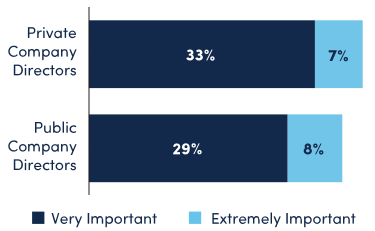
Source: 2025 NACD Public Company Board Practices and Oversight Survey, n=154; 2025 NACD Private Company Board Practices and Oversight Survey, n=84
Q: How important is it that your board improves in the following areas related to cyber-risk oversight?
Strong board–management relationships in cybersecurity are not about frequency of meetings alone; they are about trust, shared language, and consistent integration of cyber issues into strategic discussions.
Boards should push for reporting from the CISO that uses business metrics (e.g., potential revenue loss, downtime costs, regulatory penalties) rather than purely technical jargon. Directors should approach cyber risk conversations as they would financial or operational reviews: what are the strategic exposures, what is the economic impact, and how does this risk align with business objectives?
Boards should ensure their governance practices and structures for engaging the CISO and receiving cyber-risk reporting are fit for purpose.
Cyber resilience depends on coordination across the enterprise and with external partners. Encourage management to include the cyber-risk team in enterprise-wide resilience exercises (e.g., supply chain disruptions, operational continuity planning). They should also ask how the organization collaborates with industry and cross-sector peers, ISACs, and regulators to address systemic cyber threats.
Boards should cultivate direct, recurring interactions with the CISO or equivalent executive. Best practices include
If the cyber-risk team feels pressure to deliver only good news, boards will be blind to systemic weaknesses. Reinforce that the board values transparency, and that escalation of problems will not be punished, but used constructively. Questions should focus on what is not being reported and how near-misses are used to improve processes.
Cyber reports should not be isolated from other risk areas. Boards should require that cyber-risk metrics be presented alongside financial, operational, and strategic risk dashboards. This integration enables directors to see how cyber exposures affect overall business objectives.
Even with strong reporting, boards must have sufficient baseline literacy to interpret what they hear. Boards can develop this expertise and competence through training, appointing cyber-experienced members, or retaining independent advisors. Without it, relationships risk becoming performative and circular rather than substantive.
The board should ask how the cyber-risk team works with legal (regulatory compliance), operations (business continuity), finance (quantifying losses), and HR (training employees) and whether the CISO participates in strategic discussions and decision making with other senior leadership. Further, boards should also review whether the current positioning of the cybersecurity team within the organization and the CISO’s reporting line remain fit for purpose.
CISA Cybersecurity Performance Goals
These common protections help all critical infrastructure entities—large and small—reduce the likelihood and impact of known risks and adversary techniques
These resources help organizations understand and improve their management of cybersecurity risk
World Economic Forum, Principles for Board Governance of Cyber Risk
A reference for corporate directors as they set their organization’s cybersecurity strategy and engage with stakeholders on the issue of cyber risk
Toolkit For Action
Fifteen specialized tools with best practices that enable boards to address common, board-level cyber-risk oversight issues.

Boardroom Tool
Structure oversight of ransomware preparedness and response, by focusing on risk governance, scenario planning, and decision-making under pressure.
Boardroom Tool
Learn a strategic path for overseeing and strengthening an organization’s incident response (IR) capabilities over four core pillars.
Boardroom Tool
Gather cybersecurity-related questions the director should consider in discussions within the board, with management, and with other interlocutors regarding emerging technologies and their impact on the organization’s strategy.
Boardroom Tool
Explore an overview of anticipated impacts and applications of quantum technologies, and collect suggested cybersecurity-related questions for board members to discuss with management as the technology matures and transitions into the marketplace.
Boardroom Tool
Review information to help successfully understand rapidly evolving AI capabilities, the risks and opportunities of AI investments, and provide the leadership, governance, and oversight that will enable the business to thrive in the age of AI.
Boardroom Tool
Obtain a structured approach to governance of cloud use, focusing on oversight of vendor selection, shared responsibility, and measurable risk management.
Boardroom Tool
Understand the definition of insider threat, the categories of insider incidents, types of insider threat actors and the board’s responsibilities with specific actions they can perform to ensure executive management is adequately addressing insider threats.
Boardroom Tool
Collect questions to ask to ensure that key components of third-party and supply chain risk management are being managed effectively.
Boardroom Tool
Assess cybersecurity risks at key stages of a merger or acquisition transaction and compile suggested questions for board members to discuss with management at each stage.
Boardroom Tool
Discover how boards can strengthen relationships with cyber-risk leaders to promote strategic integration, resiliency, transparency, accountability, and trust.
Boardroom Tool
Analyze how directors can leverage key cybersecurity metrics to evaluate organizational performance, benchmark against industry practices, and fulfill their fiduciary duties.
Boardroom Tool
Examine examples of foundational practices and metrics boards may leverage to determine the soundness of cyber-risk oversight during regularly scheduled cybersecurity briefings.
Boardroom Tool
Consider these questions in preparing a proxy statement or other disclosures related to the board’s oversight of cybersecurity.
Boardroom Tool
This boardroom tool provides practical, actionable steps to minimize directors’ personal risk exposure, reduce corporate risk exposure, and strengthen resilience against sophisticated cyber threats.
Boardroom Tool
This tool covers actions the Federal Bureau of Investigation (FBI) and US Department of Justice (DOJ) can take against cyber actors, and when and how to report a cyber incident.
Final Days to Save $1,500
on NACD Directors Summit™
2026 Registration
Register by Thursday, April 30 to take advantage of this exclusive discounted pricing.
October 11-14, 2026
The Gaylord National Harbor | Washington, DC Area