


Director's Handbook
Introduction: The New Mandate for Cyber Oversight
This introduction, featured in the fifth edition of the NACD-ISA Director's Handbook on Cyber-Risk Oversight, provides an overview of the essential foundation for board members navigating technology governance and fiduciary duty. Learn how emerging technology, new global regulations, and shifting threat landscapes are transforming cybersecurity from a technical risk into a strategic business opportunity.
A convergence of escalating threats, growing business opportunities enabled by new technologies, and a transformed regulatory landscape has created a new reality: cyber risk is a business risk and business opportunity.
The emphasis though, is not singularly on bigger walls and faster detection. The importance of technology to most companies’ success, and the economy more broadly, means cybersecurity must be a core pillar of an organization’s strategy development, financial planning, and operational execution. As a result, cybersecurity oversight is a core component of a board’s fiduciary oversight duties.
Globally, according to Microsoft’s Digital Defense Report, over 600 million cyberattacks are tracked per day. Other sources estimate that the economic losses from cyberattacks will soon approach $20 trillion a year—up from $8 trillion in 2022. For example, one major international retail company reported that a single 2025 ransomware attack originating from its supply chain is expected to erase one-third of its annual profits by disrupting core business operations. Similarly, an international luxury automobile company had to halt production in multiple locations due to a ransomware attack, affecting thousands of suppliers and demonstrating cascading effects across its supply chain.
More broadly, US critical infrastructure, including our energy, water, and telecommunications networks, has been compromised by nation-state related actors who have been able to remain undetected in these systems for over two years, “living off the land”, giving them the ability to launch attacks that create unforeseen impacts and losses.
The expanding threat environment demands renewed vigilance from boards. The era of passive oversight is over. Cybersecurity has evolved from a peripheral technology issue into a central pillar of corporate governance and a core element of fulfilling the board’s fiduciary duties.
A convergence of escalating threats, new technologies, and a transformed regulatory landscape has created a new reality: cyber risk is business risk, and its effective governance is now a major, and direct, responsibility of the board.
Principles for Board Oversight of Cyber Risk
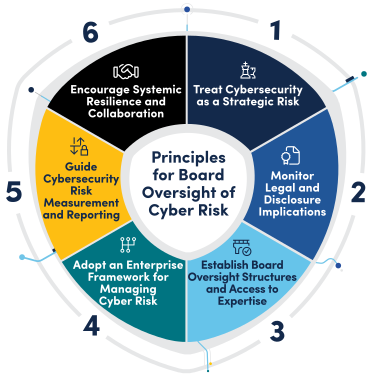
This new environment is defined by four interconnected forces:
1. Centrality of Technology to Strategic Success
Emerging technologies like generative AI are creating a triple challenge for companies and boards. These technologies offer the potential for immense value creation and productivity gains, but they are being weaponized to create more effective attacks while also serving as an attack vector and introducing novel risks to the enterprise. Attacks have already moved from AI-assisted to AI-generated and managed cyberattacks, and 380 of the Fortune 500 companies, 76 percent, included an AI risk factor in their disclosures. AI is now a routine agenda item for 62 percent of public company boards —more than double the number from 2023. Yet few boards have taken steps to assess AI risks, integrate AI oversight into board committee responsibilities, or evaluated the AI impacts on corporate strategy.
2. Increased Sophistication of Attackers and Adversaries
Ransomware syndicates to state-sponsored groups like China’s “Volt Typhoon” are operating with unprecedented sophistication. They are no longer just breaching networks; they are infiltrating critical infrastructure and exploiting the entire digital supply chain, as evidenced by a 431 percent surge in such attacks in recent years.
3. The Transformation of Legal and Regulatory Liability
Regulators are now formally codifying the board’s role in cyber oversight. The SEC’s 2023 disclosure rules, which mandate board-level reporting on cyber governance, and the EU’s NIS2 Directive, which can impose direct liability on management bodies, have made effective oversight a matter of legal compliance, not just best practice.
4. Expanded Board Responsibilities and Expectations
Board oversight of cybersecurity has evolved from a technical IT concern to a fundamental governance responsibility. Directors are now expected to understand how cyber risks impact enterprise value, strategic objectives, and stakeholder trust.
The confluence of these forces means that a reactive, technically focused approach to cybersecurity is no longer defensible. Boards must now lead from the front, ensuring that a robust, proactive, and resilient governance model is in place. This new approach includes
- positioning cybersecurity as a strategic business issue aligned to business objectives
- maturing organizational cybersecurity strengths and allocating appropriate resources to manage technology risk
- bolstering resilience for effective recovery from incidents and disruptions
- elevating security across the ecosystem and industry to promote collective cybersecurity
Ultimately, the shifting environment demands rigorous board-level engagement that moves beyond a reactive, compliance focused, “check-the-box” mentality towards a proactive, risk and data informed, strategic governance approach. Boards that fail to improve their cyber-risk oversight in this new environment risk more than just operational disruption; they risk poor strategy development and execution, erosion of shareholder value, and a loss of shareholder and stakeholder trust. Directors can leverage the principled guidance in this handbook to proactively integrate cyber-resilience into the corporate strategy, ensuring that the organization is not merely defending its walls, but is strategically positioned to navigate and respond to the inevitable volatility of the digitally-enabled economy.
The mandate is clear: govern with foresight or remain vulnerable to the consequences of inaction.
Final Days to Save $1,500
on NACD Directors Summit™
2026 Registration
Register by Thursday, April 30 to take advantage of this exclusive discounted pricing.
October 11-14, 2026
The Gaylord National Harbor | Washington, DC Area