
Boardroom Tool
Board-Level Cybersecurity Metrics
Analyze how directors can leverage key cybersecurity metrics to evaluate organizational performance, benchmark against industry practices, and fulfill their fiduciary duties.


Chapters Near You
The Chapter Network is one of the most valuable benefits of NACD membership. It’s a coast-to-coast governance community for actively engaged directors looking to cultivate meaningful peer relationships.
Chapters Near You
The Chapter Network is one of the most valuable benefits of NACD membership. It’s a coast-to-coast governance community for actively engaged directors looking to cultivate meaningful peer relationships.
Cyber-Risk Oversight Principles
Principle Five

Director's Handbook
Principle Five: Guide Cybersecurity Risk Measurement and Reporting
Effective board oversight depends on the quality of information received from management. Without clear, business-aligned reporting, directors cannot accurately assess whether an organization’s cybersecurity posture is adequate or if resources are appropriately allocated. Principle Five of the Director’s Handbook on Cyber-Risk Oversight helps bridge this gap by reinforcing that leadership must move beyond technical updates toward standardized, quantitative reports that explain cyber risks in business, financial, and operational terms. This transparent, data-driven dialogue fosters accountability, allowing boards to fulfill their fiduciary duties while protecting long-term enterprise value and building stakeholder trust.
Effective board oversight of cyber risk depends on the quality of the information it receives. Directors recognize the impact management’s reporting has on their ability to oversee cyber risk, nearly half (43 percent) of public company directors and 57 percent of private company directors, state improvements in the quality of management’s cyber-risk reporting were “very” or “extremely important” in the coming year.
Without clear, consistent, and business-aligned reporting, boards cannot assess whether the organization’s cybersecurity posture is adequate, whether resources are appropriately allocated, or whether management’s actions align with the enterprise’s defined risk appetite.
Directors Focus on Management Cyber-Risk Reporting
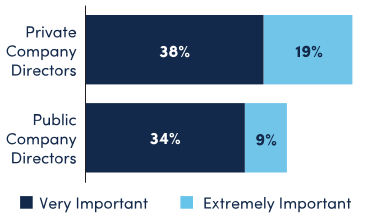
Source: 2025 NACD Public Company Board Practices and Oversight Survey, n=158; 2025 NACD Private Company Board Practices and Oversight Survey, n=85
Q: How important is it that your board improves in the following areas related to cyber-risk oversight?
Many boards still receive cybersecurity updates that are overly technical, inconsistent across business units, or disconnected from business objectives. In such cases, directors are left with little ability to gauge risk exposure in financial or operational terms or to fulfill regulatory expectations for disclosure and accountability.
Done effectively, sound cyber-risk reporting goes beyond compliance and creates strategic advantage. When boards receive concise, quantitative, and forward-looking reports, they can connect cybersecurity performance to business outcomes, assess trade-offs, and prioritize investments that reduce the most material risks. Over time, such reporting strengthens trust among regulators, shareholders, and customers, reinforcing the organization’s reputation for resilience and governance maturity.
The board should direct management to design and maintain structured reporting that ensures consistent, business-relevant communication of cyber risk. Reports should align with the broader enterprise risk management (ERM) process, using the same language, cadence, and metrics used for other forms of material risk.
To enable objective decision-making, the board can encourage the use of standard risk quantification models that translate technical metrics into probable financial loss and likelihood distributions.
Cyber-risk reporting should occur at least quarterly and immediately following any material incident or significant change in risk exposure. Management and the board can clarify clear formalized escalation criteria—such as thresholds for financial impact, customer exposure, or operational disruption—that trigger special board updates. This enables timely awareness and swift alignment between management and directors when high-impact events occur.
The board’s periodic review can begin with an executive-level dashboard summarizing:
Dashboards should be visual, concise, and comparable across reporting periods and business units. The objective is not to drown the board in data, but to elevate insights for strategic oversight.
Directors can devote time to analyzing a few critical scenarios that could significantly affect enterprise value—such as ransomware on core systems, compromise of customer data, or failure of a critical vendor. For each, the board may request:
This scenario-based approach allows the board to focus attention on the risks that truly matter while confirming that management’s mitigation efforts are prioritized accordingly.
Boards must receive timely, complete briefings on material cyber incidents. Boards and management teams should align on the escalation protocols, reporting framework, and information that works best for their situation. Common incident reporting practices include:
Boards can also participate in tabletop exercises involving both executives and directors to test response coordination and crisis communication under simulated conditions.
Directors should be provided with clear reporting on compliance with applicable regulations, including SEC, NIS-2, DORA, HIPAA, and sector-specific standards. Reports should outline:
While directors need not engage with deep technical indicators, they can monitor concise Key Risk Indicators (KRIs) and Key Performance Indicators (KPIs) that demonstrate program maturity and trend direction. Key board focus areas should include whether metrics show improvement, stability, or deterioration over time, and whether the pace of change aligns with strategic risk appetite.
The board’s fiduciary duty includes ensuring that cybersecurity resources are commensurate with risk. Periodic reviews should compare the cybersecurity budget and staffing to benchmarks, risk reduction results, and business growth. Boards can ask management to demonstrate that investments—especially in automation and AI—yield measurable efficiency gains and exposure reduction.
Cyber-risk reporting should be an ongoing conversation, not a one-way presentation. In providing oversight, directors may challenge assumptions, request alternative scenarios, and ask for comparisons across time or industry peers. Open dialogue between the board and management strengthens mutual understanding, reinforces accountability, and fosters a culture of transparency.
Boards that achieve this standard of cybersecurity reporting transform oversight from reactive compliance to strategic leadership. They gain a dynamic view of exposure, enabling them to steer the enterprise toward resilience, competitiveness, and trust. Management, in turn, benefits from informed direction, clearer priorities, and stronger support for investment in controls and innovation. Ultimately, effective cyber-risk reporting ensures that directors can fulfill their fiduciary duty with confidence—protecting enterprise value while enabling the pursuit of opportunity in a digital world.

Boardroom Tool
Analyze how directors can leverage key cybersecurity metrics to evaluate organizational performance, benchmark against industry practices, and fulfill their fiduciary duties.
Boardroom Tool
Discover how boards can strengthen relationships with cyber-risk leaders to promote strategic integration, resiliency, transparency, accountability, and trust.
Boardroom Tool
Examine examples of foundational practices and metrics boards may leverage to determine the soundness of cyber-risk oversight during regularly scheduled cybersecurity briefings.
Final Days to Save $1,500
on NACD Directors Summit™
2026 Registration
Register by Thursday, April 30 to take advantage of this exclusive discounted pricing.
October 11-14, 2026
The Gaylord National Harbor | Washington, DC Area