

The 2026 Proxy Season:
What It Revealed, and What Boards Must Do Now
Archive


NACD Northern California
Contact Us
Kate Azima,
Executive Director
programs@northerncalifornia.nacdonline.org
Find a Chapter
About The Event
This proxy season gave boards a lot to think about, from shifting investor expectations to more scrutiny of how boards explain their decisions.
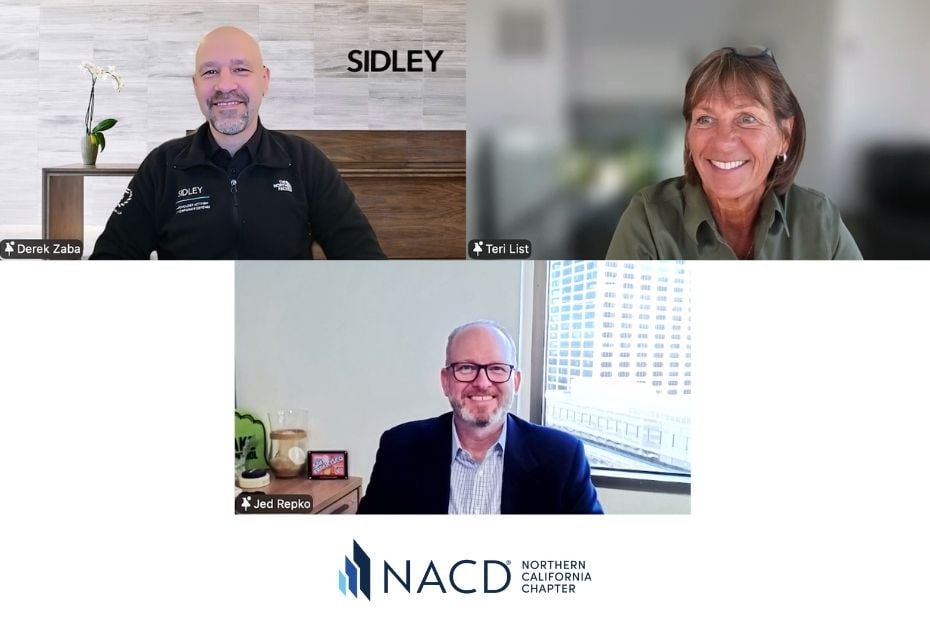
The panel featured board director Teri List (Danaher, lululemon, Microsoft, Visa) and experts Jed Repko and Derek Zaba, who shared practical insights on what the season revealed and where boards should focus next.
KEY TAKEAWAYS
Activism Trends
- Activist activity remains high and is increasing in certain sectors, including regional banking.
- The proliferation of activist funds, including spin-outs and newer entrants, increases the likelihood of facing multiple activists with sometimes different objectives, incentives and tactics.
- Universal proxy has made winning one or two board seats more achievable, while larger board changes, obtaining control and activist principal appointments remain more difficult. This iscontributing to earlier settlements where risk is manageable and fights where the activist has outsized expectations of leadership change or control is at stake.
- Do not mistake a lack of shareholder scrutiny of your strategy, governance practices and disclosures during periods of strong performance for support. Underperformance can quickly triggerfocused investor scrutiny in these areas despite having previously paid little attention to them.
Preparing for Activism
- Activists generally identify existing vulnerabilities rather than create them. Boards need to distinguish provocative tactics from legitimate concerns about strategy, operations, communicationsor leadership.
- Conduct vulnerability assessments in advance, benchmarking performance, strategy, governance and capital allocation against relevant peers to identify where the company is most open tochallenge.
- Pressure-test disclosures and messaging in peacetime, including director biographies and skills, executive compensation rationale, strategy, capital allocation and measures of progress.Companies may be doing the right things without effectively communicating them.
- Proactive shareholder engagement is a critical defense. Clearly articulating strategy, execution, progress and board oversight can establish the narrative before an activist does.
- Relatively few activism campaigns ultimately reach a shareholder vote. Boards should focus on longer-term trends rather than over-indexing on a small number of vote outcomes.
- Review bylaws, nomination procedures and campaign-response protocols before they are needed.
- Director stock ownership can also matter as a signal. Personal stock purchases may carry greater weight with some portfolio managers than boards assume.
Engagement and Different Types of Activists
- Engagement should be deliberate and sequenced, generally beginning with investor relations and management before escalating to directors. Activism is effectively investor relationsunder significantly greater pressure.
- Established activists tend to be sophisticated, well advised and predictable. Newer or smaller activists may have additional incentives to build their profile and may rely more heavily on publicity and attention-grabbing tactics.
- Founder-led campaigns require a different playbook because identity, legacy and stewardship can become intertwined with financial performance. Boards must navigate shareholderconsiderations alongside employee loyalties, management stability and the founder’s continued influence.
- Requiring D&O questionnaires as part of the nomination process can provide earlier visibility into additional nominations and improve leverage around settlement timing.
Board and Executive Dynamics
- Activists look for fractures within the board and between directors and management. Healthy debate remains essential, but boards should establish protocols in advance for maintaining cohesion and communicating consistently during a campaign.
- Robust CEO evaluation and succession planning are critical. Existing concerns can quickly become public under activist pressure, accelerating leadership decisions that might otherwisehave unfolded over a longer period.
- New CEOs can no longer assume a traditional grace period. Where urgency is already established, investors may expect immediate signs of change rather than an extended listening or assessment period.
- Demonstrating bench strength, including giving other senior executives greater visibility, can signal fresh perspectives and organizational depth without prematurely committing to majorstrategic changes.
- Settlement may be preferable where workable terms exist, but demands involving CEO removal, control or an activist principal joining the board are inherently more difficult to resolve.
AI Use on Both Sides
- AI is emerging as an activism theme, with potential vulnerabilities around investment, execution, competitive positioning and whether companies can clearly articulate how AI affects their strategy and business model.
- There is no established benchmark for the “right” level of AI investment or return, making strategic flexibility important. Operating benefits are more measurable, and companies should be prepared to demonstrate AI-related efficiencies, margin improvement and cost savings.
- AI governance is becoming a board oversight issue in its own right. Boards need visibility into evolving AI risks, principles, controls and accountability as adoption expands.
- AI is lowering the barrier to sophisticated activism. Smaller investors and retail shareholders can produce detailed analysis, polished campaign materials and even deepfake CEO videos, making it harder to separate credible challenges from manufactured noise.
- AI is also strengthening company tactical options by reducing the friction of reaching retail investors through targeted digital communications, personalized messaging and compelling visual assets.
Investor Engagement in an AI-Enabled Environment
- Institutional stewardship teams can use AI to analyze companies more deeply before engagements. Directors and management should anticipate more detailed questions and prepare with comparable rigor.
- Investor communications increasingly need to serve both human audiences and the LLMs retrieving company information. IR websites should combine strong human-facing communicationswith structured data, clear thematic headings, FAQs and accessible prepared earnings remarks.
- Make the company’s strategy, rationale, progress and responses to foreseeable criticism easy to find and understand. Authoritative company information should be structured so AI systems can readily retrieve and accurately summarize it.
Thank you to our partners.
 |
 |
NACD Northern California
Contact Us
Kate Azima,
Executive Director
programs@northerncalifornia.nacdonline.org
Find a Chapter
By registering for an NACD or NACD Chapter Network event, you agree to the following Code of Conduct.
| NACD and the NACD Chapter Network organizations (NACD) are non-partisan, nonprofit organizations dedicated to providing directors with the opportunity to discuss timely governance oversight practices. The views of the speakers and audience are their own and do not necessarily reflect the views of NACD. |