

NACD Master Class®: Technology & Innovation Oversight
Archive


NACD Chicago Chapter
Contact Us
Greg Hedges
President and Chief Executive Officer
GregHedges@ChicagoNACD.org
312-480-7030
NACD Chicago Chapter
5400 West Elm Street
McHenry, IL 60050
Find a Chapter
About The Event
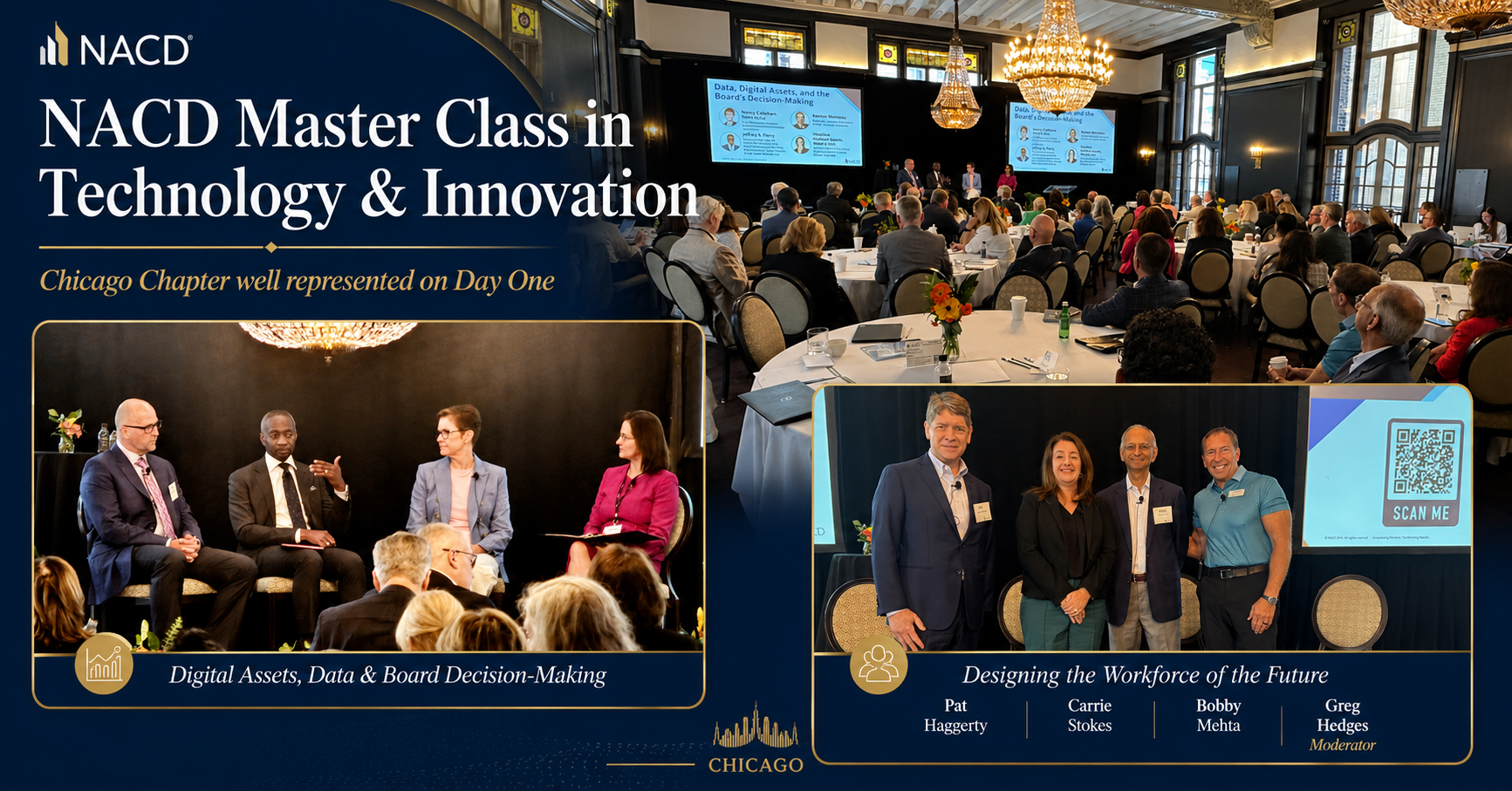
More than presentations and keynote speakers, one of the most valuable moments of NACD's Master Class in Technology and Innovation Oversight, held June 15–16 at the Chicago Athletic Association, came at the very end.
After two days of immersive learning—including expert briefings, tabletop exercises, case studies, panel discussions, and peer-to-peer conversations—participants were invited to pause, reflect, and synthesize what mattered most.
Working in roundtables, directors from a wide range of industries discussed three questions before each table selected a spokesperson to share its conclusions with the entire room.
What emerged was more than a conference recap. It was a candid readout of how experienced directors are thinking about AI, technology, innovation, governance, and the future of board oversight.
Executive Summary
The strongest message from the room was clear:
Boards must move beyond viewing AI as simply another risk to manage and begin governing it as a strategic capability. Doing so requires informed directors, capable management teams, disciplined governance, and investments in people every bit as much as investments in technology.
Across the room, participants emphasized that directors must improve their own AI fluency, ask better questions of management, align innovation with business strategy and organizational values, and ensure workforce readiness keeps pace with technological change.
Rather than chasing the newest technology, boards should focus on creating the governance capabilities that allow organizations to adapt continuously as technology evolves.
Three Questions for Directors
Participants worked in teams to answer three discussion questions:
- What issue, topic, or challenge is most urgent for boards to consider today regarding technology and innovation oversight?
- What action—or what question—will you take back to your own board following this program?
- What practical insight from these two days can directors begin implementing immediately?
Their responses revealed several consistent themes.
1. The Most Urgent Issues Facing Boards
AI governance requires greater board fluency.
The dominant message throughout the discussion was that boards cannot effectively oversee AI if directors do not understand it.
Participants emphasized that directors should:
- Increase their own AI literacy.
- Become more fluent as technology evolves.
- Treat AI as a strategic capability—not simply an audit or compliance topic.
- Continue learning rather than relying solely on management or outside advisors.
As one participant observed:
"Technology is advancing so fast we need to adapt at least as fast as the world around us."
Human capital deserves the same attention as technology.
Perhaps the most insightful observation of the afternoon was that many governance frameworks rigorously evaluate technology investments while paying far less attention to whether organizations have the people capable of delivering them.
Participants noted that:
- Innovation succeeds because of people—not technology alone.
- AI initiatives require investment in workforce capability.
- Boards should evaluate talent and organizational capacity alongside technology investments.
One participant summarized it memorably:
"Don't just fund the technology. Fund the people who have to make it successful."
Strategy should drive technology—not the other way around.
Several tables cautioned against pursuing AI simply because it is available.
Instead, boards should begin with fundamental questions:
- What business problem are we trying to solve?
- Does this support our strategy?
- Does it reflect our culture and values?
- How will it create measurable value?
Boards must become more forward-looking.
Participants consistently encouraged boards to spend less time reacting and more time anticipating.
That means developing processes to identify:
- emerging technologies,
- future risks,
- competitive opportunities, and
- changing business models.
As several participants observed, today's AI discussion will inevitably become tomorrow's conversation about quantum computing and whatever follows.
Governance begins with values.
Several groups emphasized that AI governance should begin with organizational values.
Among the questions boards should ask:
- What do we never want AI to do?
- Where must human judgment remain involved?
- Who could be harmed if this fails?
2. What Directors Plan to Take Back to Their Boards
Rather than returning with answers, participants planned to return with better questions.
Strengthening board capability
Directors challenged themselves to ask:
- Do we have the right board composition?
- Do we have the right management team?
- Do we have sufficient AI expertise around the table?
Deepening engagement with management
One particularly thoughtful recommendation reframed the board-management relationship:
"What conversations are difficult for management to bring to the board—and how can we help?"
Rather than creating additional oversight, participants advocated creating greater trust.
Building an AI inventory
Many participants acknowledged they weren't fully aware of every AI initiative underway within their organizations.
Recommended questions included:
- What AI initiatives currently exist?
- Who owns them?
- What is the roadmap?
- How much are we investing?
- What outcomes are expected?
Returning to governance fundamentals
Participants repeatedly emphasized asking:
- What problem are we solving?
- What return should we expect?
- How will we measure success?
Ensuring strategic alignment
Boards should also continually ask:
- Does this AI initiative advance our strategy?
- Does it fit our culture?
- Does it reinforce our values?
3. Practical Actions Directors Can Implement Immediately
The final discussion focused on practical next steps.
Participants recommended:
Improve board AI literacy.
Continue educating directors through:
- ongoing board education,
- scenario planning,
- external experts,
- governance frameworks such as NIST, and
- practical exercises.
Make AI a full-board strategic discussion.
Rather than limiting AI to Audit or Risk Committees, participants encouraged boards to:
- discuss AI regularly,
- integrate it into strategic planning, and
- view it as a source of competitive advantage.
Inventory current AI activities.
Know:
- where AI is being used,
- what data supports it,
- who owns it,
- expected ROI, and
- associated risks.
Treat data as both an asset and a responsibility.
Participants emphasized that data represents both:
- a cybersecurity risk, and
- a strategic asset capable of creating long-term value.
Boards should oversee both protection and responsible monetization.
Maintain disciplined governance.
One memorable phrase captured the spirit of responsible oversight:
"Trust everyone—but verify."
Innovation and governance should reinforce—not compete with—one another.
Looking Ahead
The concluding roundtable demonstrated one of NACD's greatest strengths: bringing directors together to learn from experts, challenge one another's thinking, and translate emerging issues into practical governance.
The discussions confirmed that the future of board leadership will depend not only on understanding technology, but on asking better questions, investing in people, and governing innovation with the same discipline that boards have long applied to finance, strategy, and risk.
For directors, the takeaway was unmistakable: AI governance is no longer about preparing for the future—it is about leading effectively today.
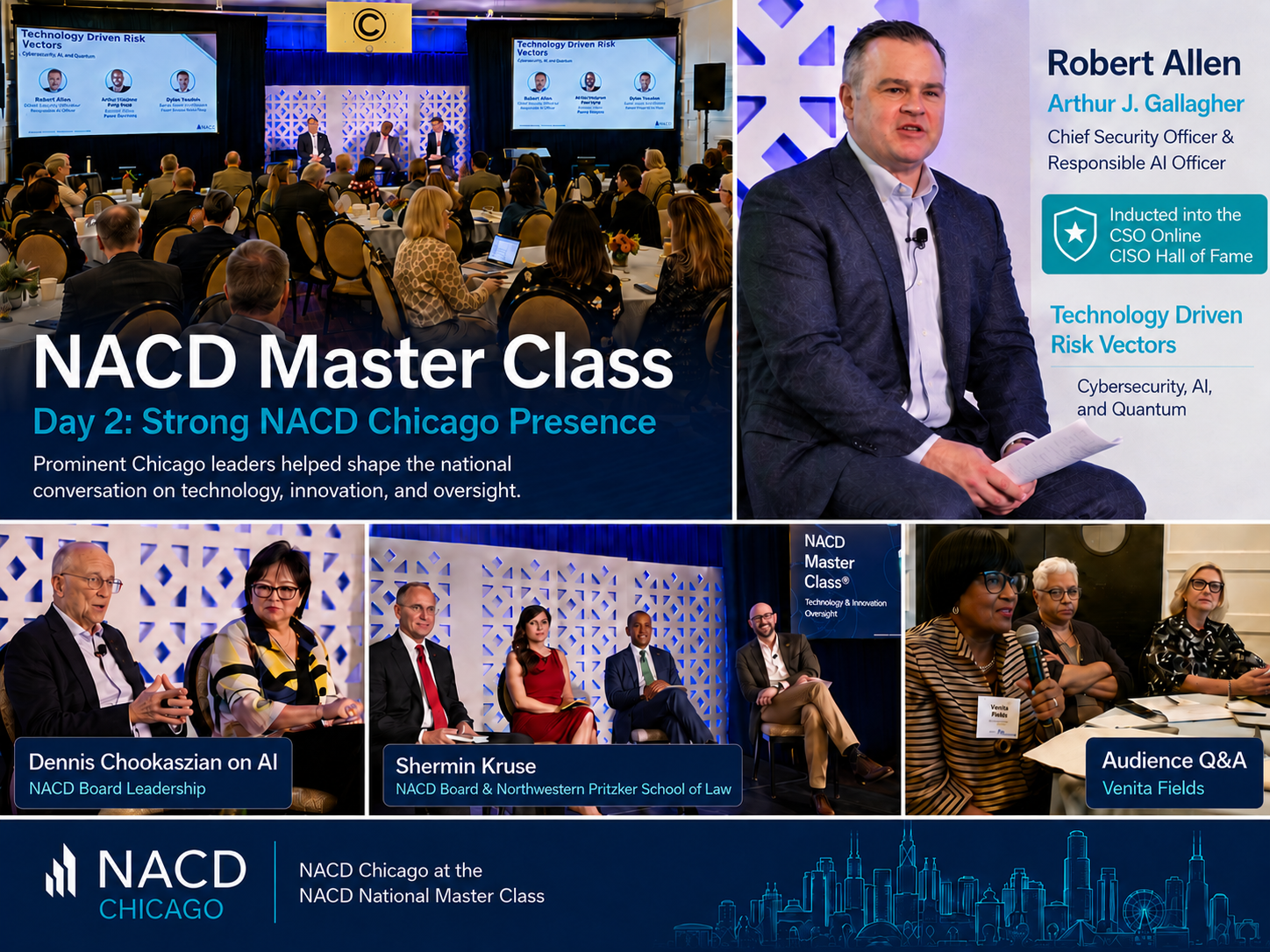
NACD Chicago Chapter
Contact Us
Greg Hedges
President and Chief Executive Officer
GregHedges@ChicagoNACD.org
312-480-7030
NACD Chicago Chapter
5400 West Elm Street
McHenry, IL 60050
Find a Chapter
By registering for an NACD or NACD Chapter Network event, you agree to the following Code of Conduct.
| NACD and the NACD Chapter Network organizations (NACD) are non-partisan, nonprofit organizations dedicated to providing directors with the opportunity to discuss timely governance oversight practices. The views of the speakers and audience are their own and do not necessarily reflect the views of NACD. |