Survey
2025 NACD Private Company Survey
This 2025 Private Company Board Practices and Oversight Survey report presents benchmarking data and insights to help directors improve their governance practices.


Chapters Near You
The Chapter Network is one of the most valuable benefits of NACD membership. It’s a coast-to-coast governance community for actively engaged directors looking to cultivate meaningful peer relationships.
Chapters Near You
The Chapter Network is one of the most valuable benefits of NACD membership. It’s a coast-to-coast governance community for actively engaged directors looking to cultivate meaningful peer relationships.
Governance Surveys
Directorship Magazine

Governance Outlook
Board governance can be a central value driver at portfolio companies. Board composition, board structure, strategic oversight, governance structures, and adaptation to market volatility can contribute to effective exits. Portfolio company boards can take several practical steps to improve their effectiveness, which can help drive investment outcomes.
Effective board governance is increasingly recognized as a critical value driver within private equity (PE) portfolio companies. As investors seek to improve returns and navigate complex market environments, understanding how board structure and leadership can impact company performance has become essential.
Amid competitive fundraising conditions, the PE sector could face some challenging market conditions heading into 2026. According to an annual survey of PE funds with a minimum target of $2.5 billion, the number of funds that are raising capital outnumber limited partners (LPs) that are able or willing to deploy into those funds, although LP demand for PE investment opportunities remains strong. The survey also indicates that a growing number of LPs recognize opportunities in the current market to invest with general partners who demonstrate resilience, flexibility, and good governance.
In this environment, there are specific levers that PE firms can pull to help strengthen the investment case for existing portfolio companies and new deals. Board governance is one such lever that could become an important differentiator, and one that LPs increasingly consider when evaluating the potential for value creation and risk mitigation.
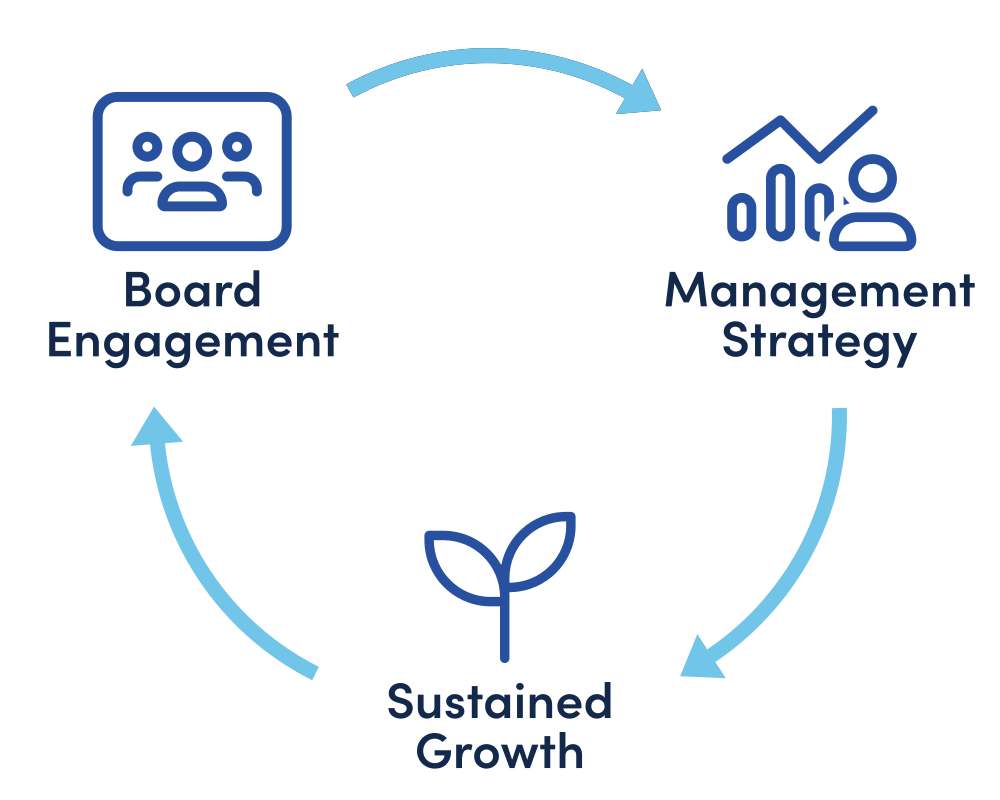
Market and industry research suggest that when PE portfolio companies embrace flexible, intentional governance structures, they are better equipped to weather market volatility, enhance strategic execution, and improve performance outcomes. For PE firms and portfolio companies, the ability to build effective governance can be critical in attracting investors and securing sustainable growth as the next cycle unfolds.
Board composition in PE portfolio companies should be intentionally dynamic. Boards should be built to match a company’s strategic context, complexity, and growth ambitions.
Many PE boards are lean, with five to seven members to enable swift decision-making. Occasionally, boards expand to a dozen or more members to tap wider experience, especially in companies with large investor syndicates or during major transformations. “Boards typically include deal team members, portfolio group leads, operating partners, management, and carefully selected independent directors who bring deep industry knowledge and perspective,” said one PE executive.*
Independent board members hold an important position within PE boards. Although their fiduciary duties of care and loyalty are identical to those of other corporations, they fulfill them under different circumstances. Compared with public company boards, who represent the collective interests of large numbers of shareholders, independent board members on PE boards are tasked with serving the interests of a smaller number of owners, namely fund sponsors.
Their operational involvement and impartial oversight can bring additional rigor and challenge to board discussions, which can be important for aligning interests and driving value creation. The independent board member’s network can also be a strategic asset for PE portfolio companies.
Directors and committee chairs are often chosen for their sector experience, technical knowledge, and personal ability to drive results. Operating partners and specialist directors are typically brought in for targeted impact—whether to lead transformation, mentor new CEOs or other C-suite executives, or guide post-merger integration—and often for defined periods. This approach can help enable the assembly of a group that is greater than the sum of its parts, capable of challenging management, driving innovation, and adapting as the company evolves.
External board members are not passive advisors.
The flexibility and willingness of directors to “roll up their sleeves” when required is often a strategic advantage for PE-backed portfolio companies.
“They are selected for their readiness to drive projects, challenge assumptions, and guide new initiatives, frequently working with management between formal meetings,” a PE executive observed. “Strategic collaboration with management is foundational.”
In the experience of PE executives interviewed for this article, some board committees consistently emerge as important for governance. While audit committees, for example, are foundational for financial integrity, risk management, and investor confidence, other committees are also prevalent, depending on the company’s specific governance strategy.
Compensation and people (or talent) committees are common as well, often tasked with CEO evaluation, incentive structures, and talent strategy. “These committees are especially important during periods of leadership transition or when scaling teams post-acquisition,” said one PE executive.* Given the sensitivity of the compensation decision, portfolio company boards may want to consider having an independent member chair such a committee. In some cases, responsibilities such as executive compensation are handled collectively by the full board, particularly when the board is smaller.
Additional committees, such as a risk or technology committee, may be relevant based on a company’s specific strategy. Smaller boards may address committee work in full board sessions, streamlining oversight but maintaining thoroughness.
Governance approaches tend to evolve as portfolio companies approach exit. Early in the investment cycle, some committees may operate less formally, focusing on agility and rapid execution. “As readiness for a public offering or strategic sale becomes a priority, boards increasingly formalize committee processes, such as documenting charters, establishing regular cycles of reporting, and embracing leading practices aligned with public market standards,” according to one PE executive.*
This blending of tailored oversight with increasing formality can create governance structures that not only improve performance but also evolve and enable a smooth, well-credentialed exit.
One way PE boards can distinguish themselves is through the level of engagement they have with portfolio company leadership. Effective boards often maintain active communication through regular CEO calls and monthly business reviews, including ad hoc engagement between or before formal meetings. These sessions often dive deep into operational challenges and upcoming priorities, in addition to reviewing historical results. Their quarterly board meetings are often structured as forums for strategic debate and forward-thinking discussion.
To monitor performance, PE boards should consider whether management needs to refine reporting practices early in the “hold period” prior to exit, when the company is sold to a new owner/goes public and original investors receive their returns. Custom dashboards of key performance indicators and scenario analyses can reflect both investor and business circumstances. A tailored, data-rich approach to oversight supports not only accountability but also agility to react to emerging risks and opportunities.
Boards and leadership teams should work together to create strategic road maps, align on growth pathways and mergers and acquisitions (M&A) plans, and plan responses to disruptions and risk management.
Strong risk management is a core expectation in today’s unpredictable environment, although the extent to which PE-backed companies utilize enterprise risk-management programs can vary, depending on the development stage. Alternative approaches can include a more targeted risk-management strategy by the audit committee or full board and use of third-party risk analyses. Portfolio companies can enhance their processes by deliberately documenting the entity’s top risks and regularly discussing them at the board level.
Adaptability is also a hallmark of good PE governance. Boards need regular dialogue about evolving macroeconomic, competitive, and industry-specific threats. Scenario planning exercises—often initiated during times of heightened market volatility—can provide structured, nimble ways to help leadership pivot as required.
Clear, open lines of communication between the board and management are important for fast, effective responses.
Ongoing learning can fuel board effectiveness as much development occurs through mentorship and hands-on experience, although formal training programs for new directors are becoming more common. The rigor of candid strategic and risk conversations remains a defining trait of boards that consistently add value.
Effective board governance can enable higher value exits for PE portfolio companies. Companies with strong board practices often command higher exit multiples and enjoy smoother transitions and higher values during initial public offerings (IPOs) or other liquidity events. Increased oversight and active risk management, which have been identified by institutional investors and strategic acquirers as contributing factors, may yield better exit performance.
Good governance can help de-risk companies and guide operational improvement. PE-backed companies with formal board structures, independent director oversight, and well-documented processes are more likely to be flagged by buyers as investment-ready. “Audit and compensation committees, frequent board reporting, and independent director participation are routinely emphasized in management presentations to potential buyers, helping build trust and demonstrate organizational maturity,” said one PE executive.*
“Rising expectations by both LPs and regulators are also helping accelerate the formalization of governance,” a PE executive noted. More LPs now require detailed reporting on governance practices and expect boards to address emerging challenges. Some PE firms have responded by embedding these requirements into board responsibilities and leveraging annual third-party reviews to document compliance—a shift that may drive exit readiness and reputational value for portfolio companies and their sponsors.
Governance effectiveness also supports companies throughout the hold period: driving earnings growth (typically measured as earnings before interest, taxes, depreciation, and amortization (EBITDA), improving operational efficiency, and enhancing management alignment. Notably, boards that invest in their own development—through ongoing education, mentorship, and skills diversification—may be well positioned to adapt to market volatility and improve the odds of effective outcomes across exit types.
Looking toward 2026, PE firms and portfolio companies may consider some strategic governance moves to help required value. These might include the following:
Board composition. Tailoring board composition to the company’s circumstances and value-creation strategy can be critical. PE sponsors should consider the value of selecting directors not just based on impressive résumés but also for demonstrated relevance (such as sector experience, operating experience, or specific skills that map directly to the business plan). Independence is also important, paired with deep knowledge and a willingness to probe. Diverse perspectives across experience, background, and mind-set are a benefit, in which each member is committed to driving value and constructively challenging management.
Establish and evolve committee structures. Ideally, committee structures are designed to be pragmatic, purposeful, and aligned to the life cycle of an investment. Audit committees are typically established first, reflecting leading practice for financial integrity and oversight. Compensation or people committees provide additional rigor around talent and incentives. When emerging business priorities call for deep technical or functional oversight, such as digital transformation (including AI), cybersecurity, or M&A integration, PE sponsors may consider forming specialized committees, bringing in outside skills, or engaging operating partners through outsourcing. Committee responsibilities and processes should become more documented and formal as the company moves toward an exit.
Prioritize strategic and risk dialogue. Effective boards are forward-looking. Boards should consider devoting time to open debates about strategy, scenario planning, and emerging risks, whether from industry disruption, cyber risk, regulatory change, or other drivers of governance. Audit committees (and risk committees, if applicable) may also want to consider performing regular, structured reviews of the company’s primary risks and mitigation plans. This future-focused approach can help accelerate growth and mitigate risks on the path to exit.
Invest in governance structures for board effectiveness. Onboarding, mentorship, and ongoing education are important, particularly as more junior PE professionals or first-time directors take on more responsibility. Targeted, functional training and ad hoc learning sessions can help elevate directors’ abilities to contribute. Embedding a feedback culture—self-assessment, peer review, and coaching—can foster continual improvement and help directors step confidently into their governance roles. The board chair also has an important role in helping set and drive the culture of the board, which includes setting the tone for agility and engagement and creating impact through good governance.
As we enter 2026 and the market continues to evolve, PE firms that prioritize tailored board structures, active director engagement, and continuous board development may differentiate themselves with investors and buyers. By investing in dynamic, purposeful boards, PE sponsors demonstrate strong stewardship and commitment to good governance, meeting the increasing expectations of LPs and positioning portfolio companies for sustained growth in a rapidly changing landscape.
As used above, Deloitte refers to a US member firm of Deloitte Touche Tohmatsu Limited, a UK private company limited by guarantee (DTTL). This article contains general information only and Deloitte is not, by means of this article, rendering accounting, business, financial, investment, legal, tax, or other professional advice or services. This article should not be used as a basis for any decision or action that may affect your business. Before making any decision or taking any action that may affect your business, you should consult a qualified professional advisor. Deloitte shall not be responsible for any loss sustained by any person who relies on this article. Copyright © 2025 Deloitte Development LLC.
Author Bio Statements
Guy Langford is a partner in the Strategy & Transactions practice at Deloitte & Touche LLP, focused on leading services into portfolio companies and serving the transaction needs of PE complexes.
Jason Menghi is a partner with Deloitte & Touche LLP and is the US Private Equity Audit & Assurance Leader, bringing more than 27 years of experience working with PE firms and portfolio companies on financial oversight and board governance.
Christine Davine is a partner with Deloitte & Touche LLP and the managing partner of Deloitte’s Center for Board Effectiveness, which helps directors fulfill their oversight responsibilities and supports experienced and aspiring board members in all aspects of board service.
Maureen Bujno is a managing director with Deloitte & Touche LLP and serves as the Governance Services Leader in the Center for Board Effectiveness, where she advises boards and committees on roles, hot topics, and leading practices.
Contributors
*The following individuals participated in interviews that helped inform the content of this article:
David Edelson, Managing Director, Private Equity, Bain Capital LP
Steven Ko, Founding Partner, BayPine LP
Christopher Vinciguerra, Managing Director, Nautic Partners LLC
About the Center for Board Effectiveness
Deloitte’s Center for Board Effectiveness helps directors deliver value to the organizations they serve through a portfolio of high-quality, innovative experiences throughout their tenures as board members. Whether individuals aspire to board participation or have extensive board experience, the Center’s programs enable them to contribute effectively and provide focus in the areas of governance and audit, strategy, risk, innovation, compensation, and succession.
About Deloitte
Deloitte provides industry-leading audit, consulting, tax and advisory services to many of the world’s most admired brands, including nearly 90% of the Fortune 500® and more than 8,500 U.S.-based private companies. At Deloitte, we strive to live our purpose of making an impact that matters by creating trust and confidence in a more equitable society. We leverage our unique blend of business acumen, command of technology, and strategic technology alliances to advise our clients across industries as they build their future. Deloitte is proud to be part of the largest global professional services network serving our clients in the markets that are most important to them. Bringing more than 175 years of service, our network of member firms spans more than 150 countries and territories. Learn how Deloitte’s approximately 460,000 people worldwide connect for impact at www.deloitte.com/us.
This article is part of the 2026 Governance Outlook report that provides governance insights for the year ahead.

Final Days to Save $500
on NACD Master Class®
Register by Thursday, March 12 to take advantage
of this exclusive discounted pricing.
April 9-10, 2026
The Conrad | Washington, DC