Cybersecurity
What Boards Should Know About Today’s Threat Actors

NACD Members Please Log In.


Chapters Near You
The Chapter Network is one of the most valuable benefits of NACD membership. It’s a coast-to-coast governance community for actively engaged directors looking to cultivate meaningful peer relationships.
Chapters Near You
The Chapter Network is one of the most valuable benefits of NACD membership. It’s a coast-to-coast governance community for actively engaged directors looking to cultivate meaningful peer relationships.
Trending Oversight Topics
Governance Research
Governance Surveys
Directorship Magazine

Online Exclusive
Inside the Rise of Executive Mega Grants
Mega grants can retain and motivate top executives, but weak rationale can put the board and company at risk.
This AI-generated summary, based on content on this page, was reviewed by NACD editors for accuracy.
“Show me the incentive, and I’ll show you the outcome” is a quip widely attributed to Charlie Munger, Warren Buffett’s long-time partner at Berkshire Hathaway. Compensation committees almost universally grant equity incentives to CEOs or other key executives in an effort to motivate, retain, reward, and align behaviors with firm growth and profitability.
Firms increasingly consider special, one-time grants as a compensation tool in their equity incentive tool kits. While different nomenclature applies to special, one-time grants—including mega grants, moonshot grants, and transformational awards—the two defining features of these incentives are size and that they are nonstandard.
Aon maintains a market-practice database of special, one-time grants made by public companies, with data ranging from 2018 to the present. Below are a few of the grant trends that directors should understand.
 Industry Prevalence
Industries utilize and conceptualize special, one-time grants differently. The information technology, consumer product, financial services, and health-care sectors have the greatest prevalence of such awards.
Peer group practices can be a strong predictor of whether companies will use these incentives. When peers grant such awards, this increases the likelihood that an organization will also choose this approach. This is because peer practices will often be shown to the compensation committee to ensure the firm’s current program remains competitive. This is most common in biotechnology companies, as well as in the semiconductor and semiconductor equipment subsectors.
 Disclosed Rationale
Organizations’ most common rationales for special, one-time grants include strong past performance, retention, leadership continuity, succession, value creation, and transformation. Business transformation, whether general or specific, may be viewed favorably by different stakeholders, including proxy advisors and shareholders. This is especially true when measured outcomes are aligned with shareholders (e.g., through stock price hurdles that link vesting to shareholder return) and tied to the success of a new, often capital-intensive business strategy.
This is also true of grants made in recognition of prior service or performance where the executive has already been compensated. Among the firms in our database, some companies note that the standard three-year, long-term incentive performance period was insufficient or arbitrary as the investment cycle may exceed that traditional incentive cycle, which led to them providing a grant.
 Quantum
Stock price or market capitalization hurdles are widely used as vesting performance requirements. These hurdles are conditions where a predetermined stock price or market capitalization must be attained at some point during a performance period. As a result, the sharing ratio—the value the program creates for shareholders—has emerged as a preferred framework to face value, or the raw value of the potential shares at grant.
Generally, as award quantum or size increases, the associated accounting costs, proxy disclosed value, and dilution risk increases as well. These items can all be viewed negatively by different stakeholders, which underscores the importance of the program’s disclosed rationale for the award.
Less than half of firms in the Aon database choose to front-load grants, or provide the executive any additional equity while they receive the special, one-time grant. While some investors view front-loading grants favorably, others may believe doing so limits the compensation committee’s ability to impact executive behavior and focus through the annual compensation progress, including decisions around goal setting.
 Structure
About 71 percent of firms in the Aon database structure special, one-time grants as entirely performance based, whereas 20 percent of companies structure them with both performance-based and time-vested components. Only 9 percent of organizations—particularly those in the finance sector—structure the grant using time-vested components alone.
Of the firms that include a performance component in the grant, 73 percent use stock price or market capitalization hurdles. Aligning stock price returns with payout directly links the shareholder experience with the vesting and amount earned by executives. Ultimately, a firm may conclude that the selection of stock price or market capitalization may be more appropriate for the firm. But in virtually all cases, making sure there is legitimate alignment between vesting and shareholder return is essential.
For firms using stock price or market capitalization hurdles, the median number of hurdles contained in the award is four. When there are too few hurdles, payouts may not adequately differentiate performance, as interpolation between the hurdles would not occur. If there are too many hurdles, performance may be measured too granularly.
However, when award quantum or size is significant and there is a longer performance period, the share price performance required by the hurdles can also be significant. In this case, it may be reasonable that there are multiple hurdles set for the grant.
The minimum performance required for an initial payout is typically a 50 percent stock-price appreciation. The way hurdles are set is highly dependent on the performance period—five years is the most common length—and quantum. Setting hurdles is often a compensation philosophy question, with the board or compensation committee assessing the probability of attainment over the life of the award through a goal rigor analysis.
For example, knowing that a hurdle is 75 percent likely to be achieved may cause the compensation committee or board to change it. Similarly, knowing that a hurdle is only 5 percent likely to be achieved may lead to the committee or board making the hurdle less rigorous. Compensation committees and boards are often keen to balance quantum and structure directly to prevent grants from becoming disincentives or perverse incentives.
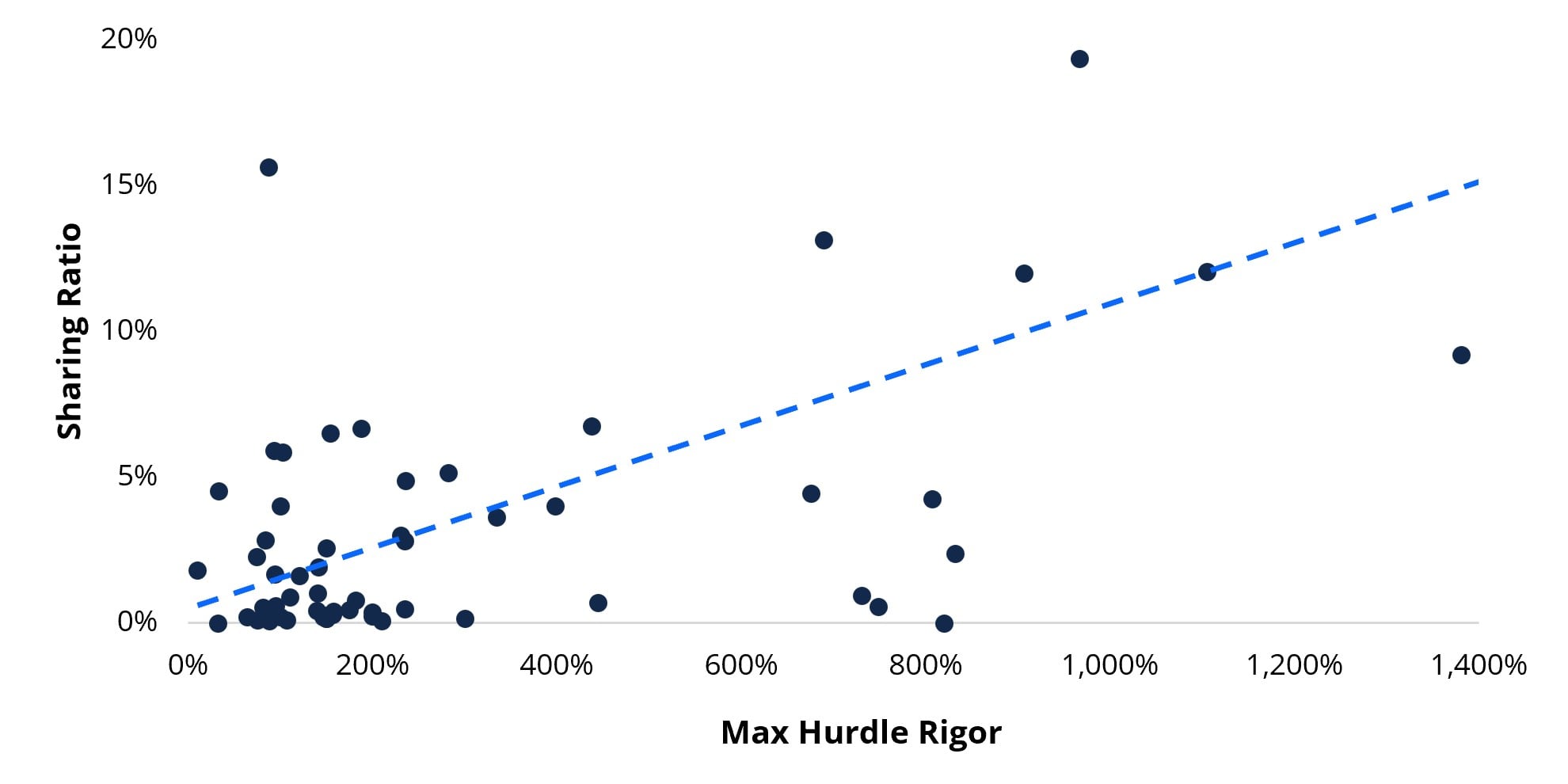
Source: Aon
Proxy advisors typically view these awards negatively and influence shareholders through say-on-pay voting recommendations. They review these special, one-time awards on a case-by-case basis, with a particular focus on rationale, quantum, performance rigor, nonrecurring treatment, and the effect on regular grants.
Shareholders may take a more nuanced view and look for shareholder-friendly items, such as the inclusion of post-vest holding periods, stock ownership guidelines, and clawback provisions. This is why the disclosed rationale is so important. When shareholders have significant concerns about the nature of the award, this can create risk for compensation committee members up for reelection.
Boards should additionally evaluate the unintended consequences of failure to attain the special, one-time grant. For instance, will a low or zero-vesting outcome be demotivating to the executive? Will the company need to modify the special, one-time award or potentially reinstate the annual equity program? If so, will that create poor optics to proxy advisors and shareholders?
This process is fraught with risks. As such, boards should ensure robust documentation of their decision-making processes around grants. This includes spending sufficient time on these decisions across multiple meetings to show that it was a deliberate, thoughtful approach.
The views expressed in this article are the authors’ own and do not represent the perspective of NACD.
Aon is a NACD partner, providing directors with critical and timely information, and perspectives. Aon is a financial supporter of the NACD.

Dan Kapinos is a partner in Aon’s executive and board advisory team and leads the North America Executive Compensation Consulting team.

Stephen Popowski is an associate partner in Aon’s executive and board advisory team, focused on issues related to equity compensation, performance award goal setting, and valuation and financial reporting.

Phillip Sanderell is a senior consultant in Aon’s executive and board advisory team, specializing in equity compensation consulting, plan design, valuation, and financial reporting.